You're Not a Salesperson, You're a Host
The thing that surprises authors most when they finish their manuscript is that they suddenly have to promote themselves. They have to become the primary voice marketing their book.
That shift from creator to promoter can be painful. You've worked so hard on your ideas. You think of yourself as an expert, not a salesperson. And the word publish literally means to make public. You're going from something private, something that lived in your brain and on your computer at your desk, to something that belongs to everyone.
A lot of authors are afraid of criticism. Bad reviews. Or worse, that no one even notices.
You Don't Have to Stand on a Street Corner
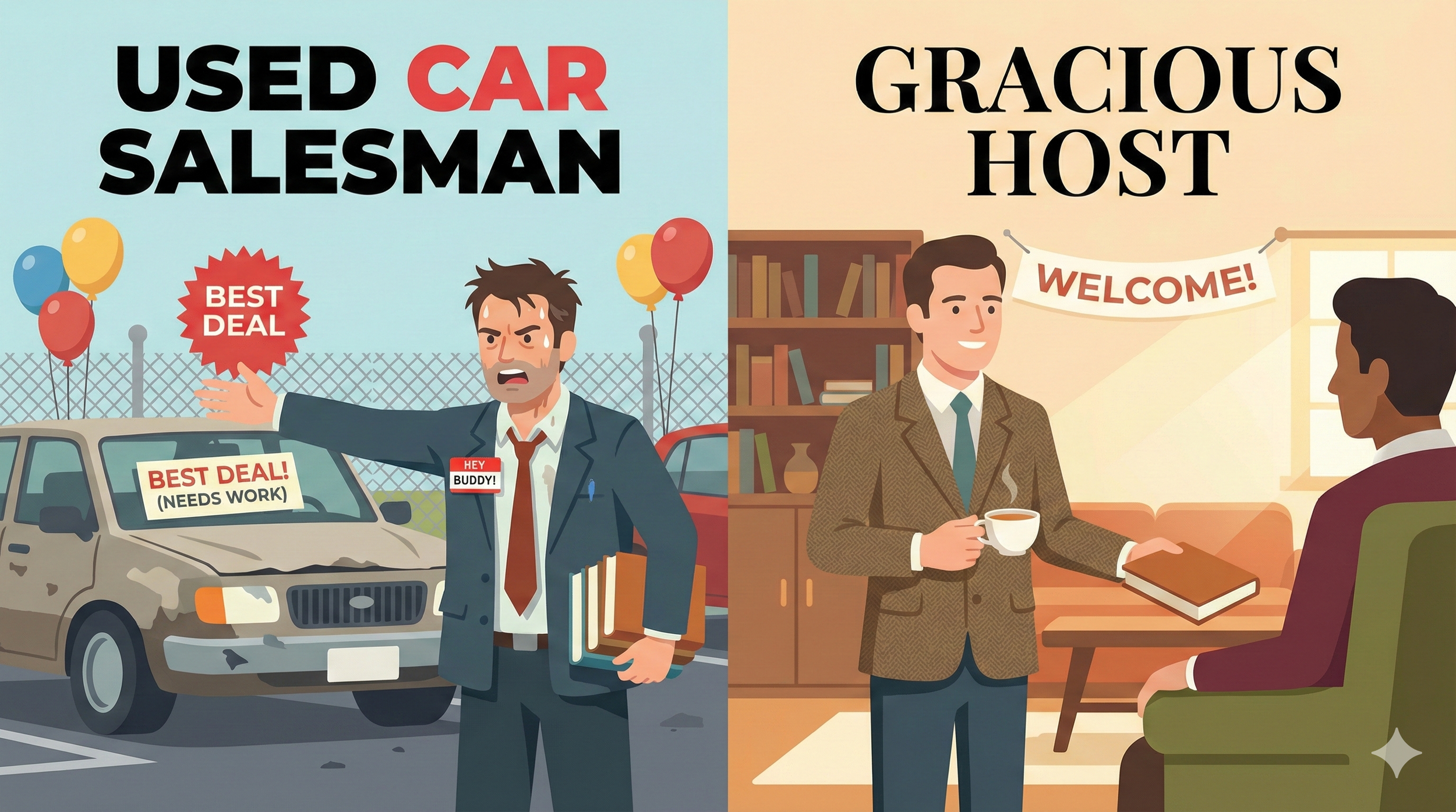
Generated by NanoBanana
The reframe I try to help authors see is this: you don't have to stand on a street corner with a big sign saying "buy my book." Instead, you gather your audience around you. You take time to connect with them. You connect with other creators speaking to the same audience.
This work can be joyful. You can end up making wonderful friends and connecting in community.
An author who really participates in the community around their book might write a regular newsletter that engages people in the ideas surrounding their subject matter. A fiction author might develop content around other titles, other authors, music in the same genre. An expert uses the book as a platform to continue the conversation around their primary topic.
The book becomes a conversation starter, not the end point.
You're the Guide, Not the Salesperson
For authors who think of reading as solitary, they need to realize that in the act of going public, they become the guide to their book. They become the person presenting it, introducing it, inviting people in, inviting people to have conversations around the work and to talk to each other about it.
Once an author embraces the idea that they are the host of the conversation, I often find there can be some relief. If you can separate yourself from the book and the bigger ideas and just be the person promoting it, like you were a marketer working for a larger cause or an activist bringing an idea out into the world, the idea itself can be the thing you're promoting. Not you or your ego or necessarily any judgment about yourself.
What You Can't Control (And Why That's Good News)
I've worked with authors who thought their book was about one thing, and then readers found unexpected themes in the work.
From day one, it's a little scary because you don't know how readers will react. You can bring in beta readers for initial feedback. But it's not really until the book hits the market that you know how it will be received. You cannot anticipate that.
Telling authors that the reaction of the public is largely out of their control can be a relief. It's not all on them. Authors can only introduce the idea in their book. They can't control how it's received.
Marketing Has to Feed Your Soul
A tried and true tactic is creating some kind of signup bonus or reader magnet. A checklist or a lesson from your book that gives people immediate value and gives you a chance to continue communicating with that reader about something they care about.
Then a regular newsletter, ideally weekly, but monthly is fine as long as it goes out every month.
I recommend that an author who has written a book digs into the creativity and spark of curiosity they discovered when they wrote the book. Write as if this free email you're sending is something you're offering as a paid publication.
But the newsletter should be easy to maintain. Because of that, it has to be interesting to the writer. You can't be writing promotional emails if that bores you to tears or makes you uncomfortable. You need to create a marketing practice that feeds both your soul and your goals.